"Black Box" Estimates to "Glass Box" Transparency
Dec 2, 2025
With the arrival of the EU's Corporate Sustainability Reporting Directive (CSRD) and the tightening of UK SDR rules, sustainability reporting is undergoing a seismic shift. We are moving from the era of "Marketing Collateral" to the era of "Audited Financial Statements."
This means your carbon data must now stand up to the same scrutiny as your balance sheet. It must be ready for Limited Assurance audits.
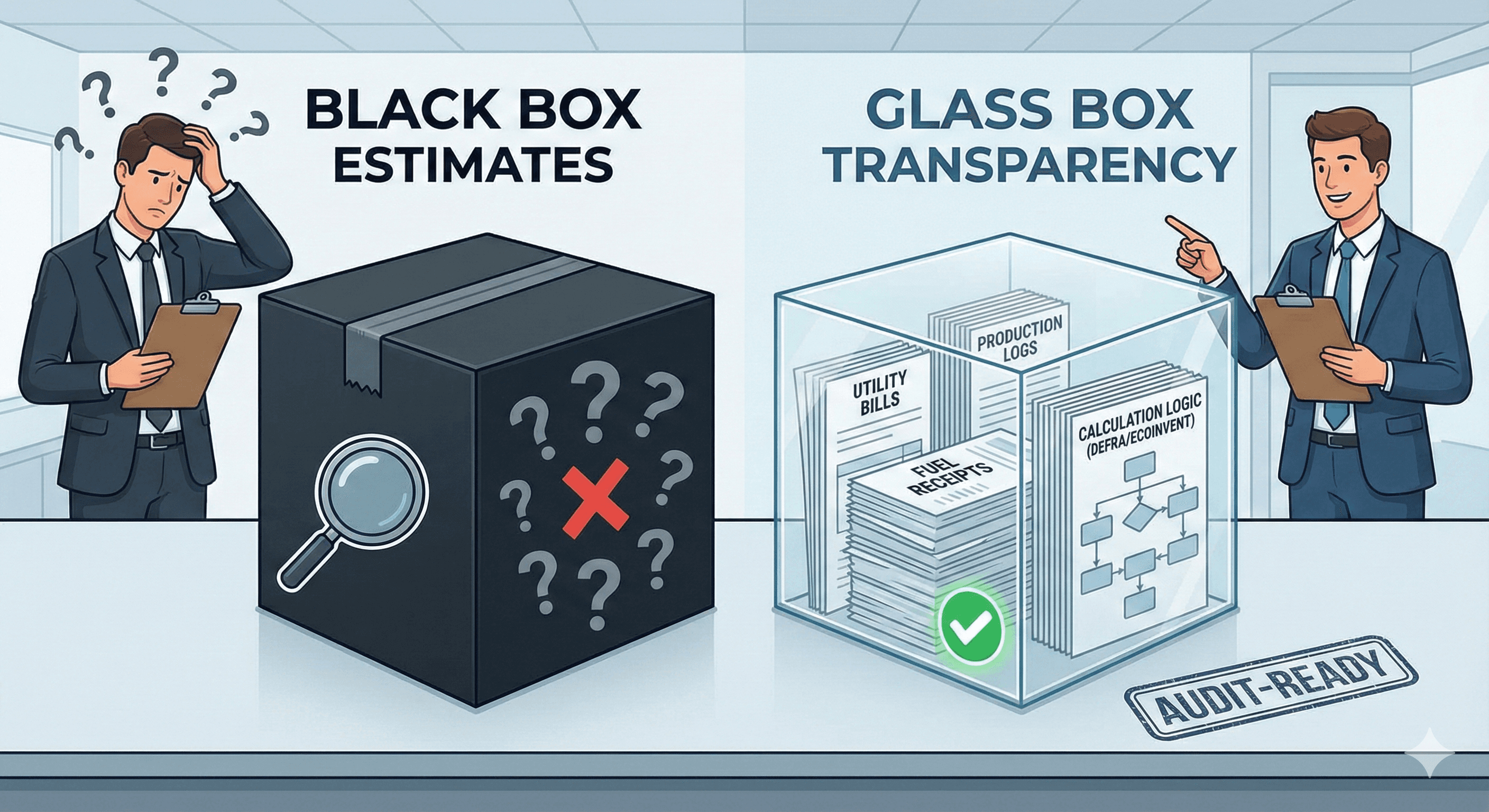
The Problem with "Black Box" Data. Many legacy ESG software platforms operate on "Black Box" methodologies. You upload a spreadsheet of spend data, the system applies a proprietary algorithm, and a single carbon number comes out.
You don't know the source. You don't know the emission factor used. You don't know the logic.
Auditors hate this. If they cannot trace the number back to its origin, they cannot sign off on it. This leads to qualified audits and reputational risk.
The "Glass Box" Standard. At CarbonAct, we operate on a "Glass Box" principle. We believe that a carbon figure is worthless without the evidence to back it up.
For every data point we deliver to our clients, we provide a transparent Chain of Custody:
The Source: A copy of the original utility bill or production log.
The Logic: The specific calculation formula used (e.g., kWh × Conversion Factor).
The Factor: The exact DEFRA 2025 or Ecoinvent factor applied, with its reference ID.
This level of granularity allows an auditor to trace any number in your report all the way back to the source document in minutes. It turns your supply chain data from a liability into an asset.